
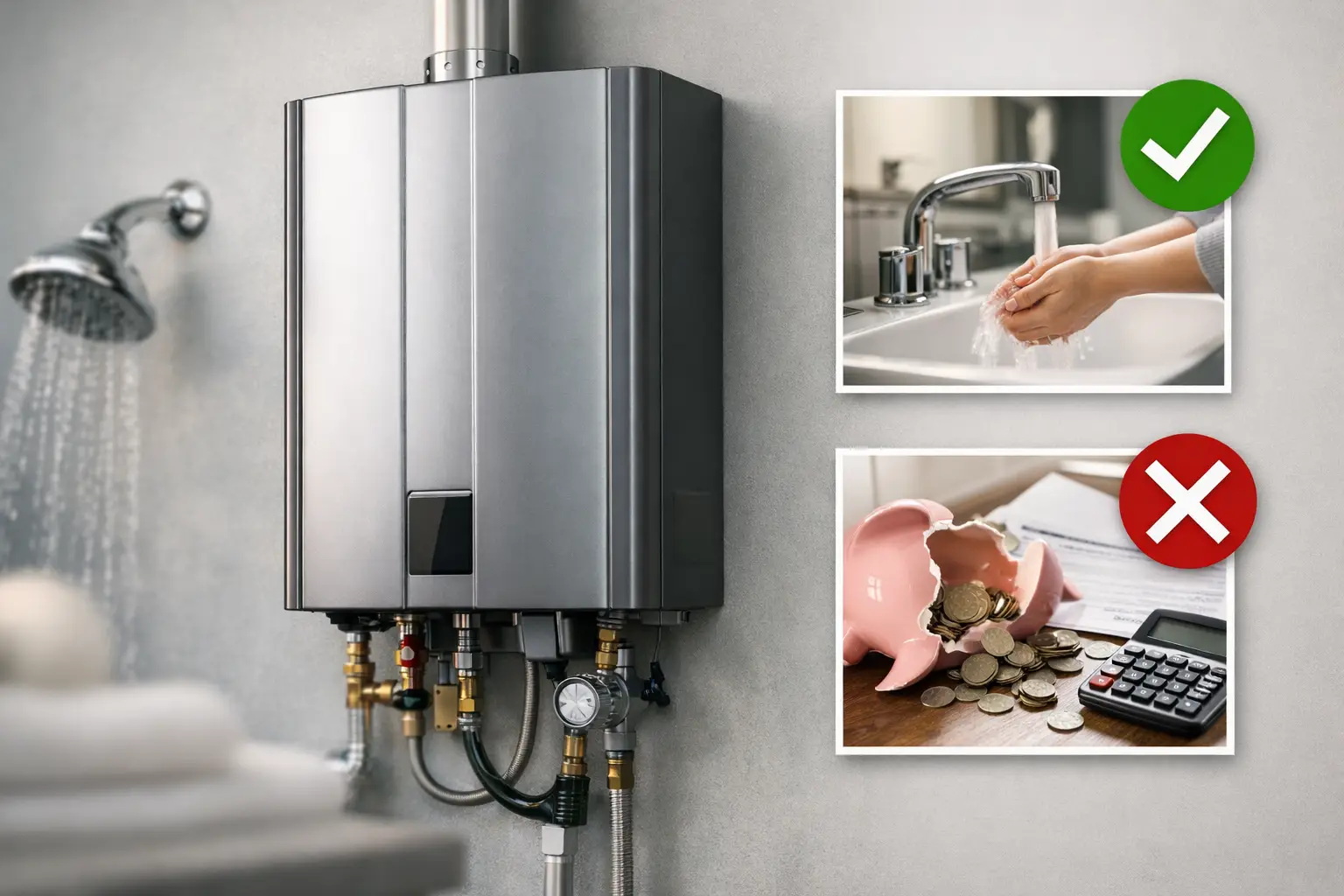
A water heater usually gets attention at the worst possible moment: halfway through a shower, during a busy morning, or when a utility-room leak becomes impossible to ignore. Understanding tankless water heater pros and cons before that day comes helps you make a clear decision based on your household’s demand, fuel source, plumbing condition, and long-term plans.
Tankless units heat water as it moves through the appliance instead of storing a full tank of hot water. Open a hot-water fixture, and the heater activates to raise the water temperature on demand. That simple difference can be a major upgrade for the right property, but it is not an automatic fit for every Northern Virginia home.
The Main Tankless Water Heater Pros
The headline benefit is simple: a properly sized tankless heater can keep producing hot water as long as there is demand. A traditional tank has a fixed supply. Once that stored water is used, the household waits for the tank to recover. With tankless equipment, the question is not how many gallons the tank holds. It is whether the unit can heat enough water at the required temperature for the fixtures running at that moment.
That matters for households where back-to-back showers are common, where someone often fills a large soaking tub, or where a family’s schedule packs laundry, dishes, and showers into the same few hours. It can also be useful for small commercial properties that need dependable hot water without dedicating floor space to a large storage tank.
More usable space
Tankless units are compact and typically mount on a wall. Replacing a bulky water heater with a smaller unit can open up useful space in a utility room, closet, basement, or mechanical area. For homeowners working with limited square footage, this is more than a cosmetic benefit.
The smaller footprint may also make access easier for future maintenance. A clean, accessible mechanical area gives a technician room to inspect connections, service the equipment, and identify a developing issue before it becomes a leak or no-hot-water emergency.
Lower standby energy loss
A storage-tank heater repeatedly uses energy to maintain the temperature of water sitting in the tank, even when nobody is using hot water. Tankless units avoid much of that standby loss because they heat water on demand.
That can reduce energy use, especially in homes with moderate hot-water consumption. The savings are real, but they depend on the type of unit, the fuel source, the incoming water temperature, household habits, and whether the equipment is sized correctly. A tankless heater is not a guarantee of dramatic utility-bill changes, but it can be the more efficient option in the right application.
Longer service life in many cases
Tankless water heaters often have a longer expected service life than conventional tank models when they are professionally maintained. Components can also be serviceable rather than requiring replacement of an entire corroded tank.
That does not mean a tankless unit is maintenance-free. Mineral scale is a real concern in any water-heating system, and neglected maintenance can reduce performance, cause error codes, and shorten the life of key components. Still, for owners planning to remain in a property for years, the service-life potential is worth considering.
Less risk from a failed storage tank
Traditional water heaters can eventually rust through and release a large volume of stored water. A tankless unit does not hold 40, 50, or more gallons in a tank, so it removes that specific failure risk.
It can still leak. Valves, fittings, internal components, and supply connections all need attention if water appears around the unit. But avoiding a full tank rupture is a meaningful advantage, particularly when the equipment sits above finished space or near belongings that could be damaged.
The Tankless Water Heater Cons to Consider
The biggest downside is that tankless performance depends on flow rate. A unit has a maximum amount of water it can heat per minute, and cold incoming water makes it work harder. In winter, Northern Virginia groundwater is colder than it is in summer, so the heater may deliver less hot-water flow during the season when your household wants it most.
If two showers, a dishwasher, and a washing machine run at once, an undersized unit can struggle. The result may be lower water temperature, reduced flow at one fixture, or a system that cannot meet the household’s peak demand. This is why the equipment should be selected based on real usage, not just the number of bathrooms in the house.
Higher upfront project cost
Tankless equipment and the work required to support it can be more involved than a like-for-like tank replacement. Depending on the home and fuel type, the project may require changes to venting, gas supply capacity, electrical service, condensate drainage, or water piping.
Older homes can be especially variable. The water heater itself may be only part of the conversation. A qualified professional should evaluate the existing setup, identify what the new equipment needs, and explain the scope clearly before work begins. That prevents surprises and helps ensure the system performs as expected after installation.
There can be a brief delay for hot water
Tankless means continuous heating, not instant hot water at every faucet. Water still has to travel through the pipes from the heater to the shower, sink, or appliance. If a bathroom is far from the unit, you may still wait for cool water in the line to clear.
Some configurations can improve delivery times, but that adds complexity. The important point is to separate two ideas: a tankless heater avoids running out of heated water, while plumbing layout determines how quickly that water reaches the fixture.
Regular descaling is not optional
Scale buildup can affect heat transfer and water flow inside a tankless unit. The risk is higher where water contains more minerals, but all systems benefit from scheduled maintenance. Ignoring it can make a high-efficiency appliance less efficient and less dependable.
Maintenance also includes checking filters, inspecting venting and condensate components where applicable, and confirming that the unit is operating safely. For landlords and business operators, this is a key planning point. A tankless unit can be a strong asset, but it needs a maintenance record rather than a set-it-and-forget-it approach.
Power and gas requirements may affect reliability
Even gas-fired tankless water heaters generally need electricity for controls, ignition, and fans. During a power outage, the unit may not operate unless the property has an appropriate backup-power arrangement.
Gas models also need adequate fuel supply and correct venting. Electric models can place a significant demand on the electrical system. These are not reasons to rule out tankless equipment, but they are reasons to have the full setup reviewed instead of choosing based on size or advertising alone.
Who Usually Benefits Most From Going Tankless?
Tankless water heaters often make sense for households with consistent hot-water demand, limited mechanical-room space, and plans to stay in the home long enough to benefit from the equipment’s efficiency and service life. They can also work well where a failed storage tank would create a serious damage risk.
They are especially appealing when a current tank heater repeatedly runs short during busy periods. If the issue is genuinely a lack of available hot water, a correctly sized tankless system can solve it. If the problem is weak shower pressure, aging pipes, fixture restrictions, or a plumbing issue elsewhere in the home, changing the water heater alone may not fix the real problem.
For a rental property or business, reliability and maintenance planning should carry extra weight. The best choice is the system that can meet predictable demand, be serviced without unnecessary disruption, and fit the property’s existing infrastructure.
Questions to Ask Before Replacing Your Water Heater
Start with your actual peak demand. Think about how many showers run at once, whether appliances regularly use hot water during those times, and whether occupants have complained about recovery time. Then consider the location of the heater, the distance to major fixtures, the age and condition of the plumbing, and the available gas or electrical capacity.
It also helps to look at why replacement is happening now. If an existing heater is leaking, producing discolored water, making unusual noises, or failing to maintain temperature, a prompt professional assessment can help identify whether replacement is necessary and whether tankless is the right direction.
For homeowners in Bristow, Gainesville, Manassas, and across Northern Virginia, Titan Jetters can help evaluate water-heater concerns with the same straightforward approach used for plumbing and drain problems: inspect the situation, explain what is happening, and give you clear next steps. The right water heater should fit your home’s demand and plumbing conditions, not just look good on paper.
