
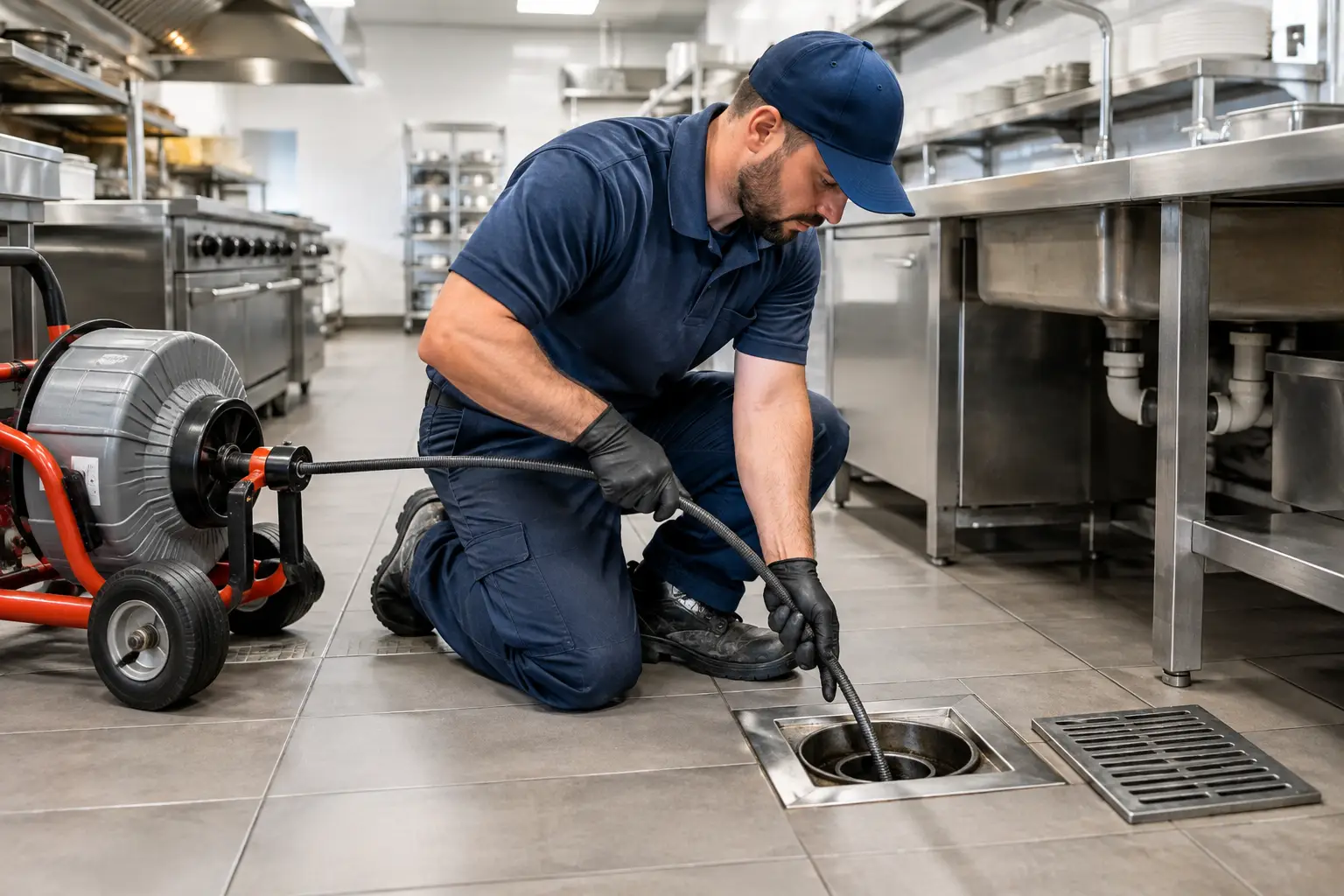
A backed-up floor drain in the middle of lunch service is not a minor plumbing issue. It can stop kitchen production, create a slip hazard, damage inventory, and put staff in a tough position with customers waiting. This commercial kitchen drainage guide explains where restaurant drain problems usually start, what warning signs matter, and when professional cleaning or camera diagnostics are the right next move.
Commercial kitchens send more grease, food debris, soap residue, and wastewater through their drain lines in one shift than many homes produce in days. That workload demands more than reacting when a sink finally stops draining. A dependable drainage plan protects service, reduces messy emergencies, and helps managers make decisions based on what is actually happening inside the pipe.
How Commercial Kitchen Drainage Works
A commercial kitchen drainage system is a connected network, not a collection of separate drains. Prep sinks, three-compartment sinks, dishwashers, floor drains, mop sinks, hand sinks, and equipment drains all send wastewater into branch lines that eventually connect to a larger building drain or sewer line.
In many food-service properties, grease interceptors or grease traps are part of that path. Their job is to separate fats, oils, and grease from wastewater before those materials reach downstream piping. They help, but they do not make the rest of the drain system maintenance-free. Grease can still coat pipes before it reaches the interceptor, and food solids, scale, and detergent residue can build up elsewhere in the system.
The result is often a restriction that develops slowly. Water may still pass through for a while, but the usable diameter of the line gets smaller. During a rush, when multiple fixtures discharge at once, that restriction can turn into a backup.
The Drain Warning Signs a Kitchen Should Not Ignore
Slow drainage is the early warning most businesses notice first. A prep sink that takes longer to empty or a floor drain that holds water may indicate grease accumulation, food debris, scale, or a developing blockage farther down the line.
Gurgling sounds matter too, especially when one fixture drains and another fixture reacts. For example, water draining from a sink may cause a nearby floor drain to bubble. That can point to a restriction in a shared line. Persistent odors around drains can also signal trapped organic buildup, stagnant water, or a venting issue that needs a proper inspection.
A backup from a floor drain is more urgent. Floor drains are commonly the lowest point in a kitchen drainage system, so they may be the first place wastewater appears when a downstream line cannot handle the flow. Do not treat that as a simple surface-drain problem. The visible water is often a symptom of a larger line issue.
Other red flags include recurring clogs in the same area, water appearing around equipment, drains that slow down during busy periods, and grease interceptor problems that return soon after routine service. Repeated symptoms usually mean the underlying cause was never fully removed or identified.
Why Grease Is Only Part of the Problem
Grease is a leading cause of commercial kitchen drain trouble, but it is rarely the only material in the pipe. Hot grease may flow freely when it enters the drain, then cool and stick to the pipe walls farther downstream. Over time, that coating catches food particles, coffee grounds, soap residue, and other debris.
Older properties can have additional challenges. Cast iron drain lines may develop internal corrosion and rough scale. That rough surface catches debris easily and reduces flow capacity. In some cases, a kitchen may have a partial grease blockage plus pipe scale, offsets, damaged sections, or a main sewer line restriction. Clearing only the easiest portion of the clog may provide short-term relief without correcting the reason it keeps coming back.
That is why the right service depends on the condition of the line. A cable machine can be effective for opening certain blockages. Flex-shaft cleaning can remove buildup in smaller lines. Professional hydro jetting can clean heavy grease and residue from appropriate piping, while pipe descaling may be needed when mineral scale or cast iron corrosion is affecting flow. The best method is the one that fits the pipe, the blockage, and the condition confirmed during diagnosis.
A Commercial Kitchen Drainage Guide to Professional Diagnosis
Guesswork costs restaurants time. When a kitchen has recurring drainage problems, the goal should not be to simply get water moving for the next hour. The goal is to find out where the restriction is, what it is made of, and whether the pipe itself has a condition that cleaning alone cannot solve.
A professional service visit often begins by identifying which fixtures are affected and when the symptoms occur. If a single sink is slow, the issue may be close to that fixture. If several fixtures back up or a floor drain overflows, the problem may be in a shared branch line, building drain, or main sewer line.
Sewer camera inspection is especially valuable when problems repeat, when there is a history of backups, or when the visible symptoms do not match a simple clog. A camera can show grease accumulation, scale, standing water, pipe damage, root intrusion in exterior lines, or other conditions that affect the repair plan. It also provides a way to verify results after cleaning.
For a busy restaurant, that level of diagnosis matters. It helps management understand whether the immediate need is drain cleaning, more thorough hydro jetting, pipe descaling, grease-related maintenance, or a repair discussion. Clear findings make it easier to plan downtime and avoid paying for the same temporary fix over and over.
Cleaning Methods and When They Make Sense
There is no one-size-fits-all answer for commercial kitchen drains. The right approach depends on pipe material, pipe condition, access points, the type of buildup, and whether wastewater is actively backing up.
Professional drain cleaning is often the starting point for a localized clog or a line with food debris and routine buildup. When grease has heavily coated the pipe walls, hydro jetting may be the more complete cleaning method because it uses high-pressure water to break up and flush accumulated residue. It is not automatically appropriate for every line, particularly if the piping is damaged or its condition is unknown. That is one reason an experienced technician evaluates the system instead of treating every clog the same way.
For older cast iron, descaling may be recommended when corrosion and hard buildup have narrowed the interior of the pipe. This is a different problem from soft grease buildup. A line can look open after a basic clearing but still drain poorly because the pipe wall remains rough and restricted.
A camera inspection after the line is cleaned can confirm whether the flow path is clear and reveal any remaining concerns. That proof is useful for restaurant owners, landlords, and property managers who need to document what was found and make informed maintenance or repair decisions.
Reducing Disruptions Between Service Calls
Daily kitchen practices influence how quickly a drain line builds up, but staff should not be expected to diagnose or repair commercial plumbing problems. The practical focus is keeping inappropriate materials out of the drains, using grease-control procedures consistently, and reporting changes in drainage before a backup occurs.
Kitchen managers should also know which drains connect to the same line and keep a record of repeated problem areas. If the dish area slows every few months, or a particular floor drain backs up during peak service, that pattern gives a drain specialist useful information. It can reveal whether the issue is local, related to the grease system, or developing farther downstream.
Scheduled professional maintenance can make sense for kitchens with high grease volume, older piping, or a history of emergency backups. The right interval depends on usage and the condition of the system. A high-volume restaurant may need more attention than a small office kitchenette, while a newer line with good flow may not require the same level of service. The point is to base maintenance on real conditions, not a generic calendar recommendation.
When to Call for Commercial Drain Service
Call for professional help right away when wastewater is coming up through a floor drain, multiple fixtures are affected, kitchen operations are being interrupted, or drains repeatedly clog after basic clearing. These are situations where fast response and accurate diagnosis can prevent a small restriction from becoming a shutdown.
For restaurants and commercial properties in Gainesville, Bristow, Haymarket, and Manassas, Titan Jetters provides commercial drain cleaning, hydro jetting, sewer camera inspections, descaling, and sewer diagnostics focused on finding the cause of the problem. The goal is straightforward: restore flow, explain what is inside the line, and give you clear options without guesswork.
A kitchen drain should disappear into the background of a successful shift. If yours is demanding attention, acting before the next rush can protect your staff, your service, and the business you worked hard to build.
