
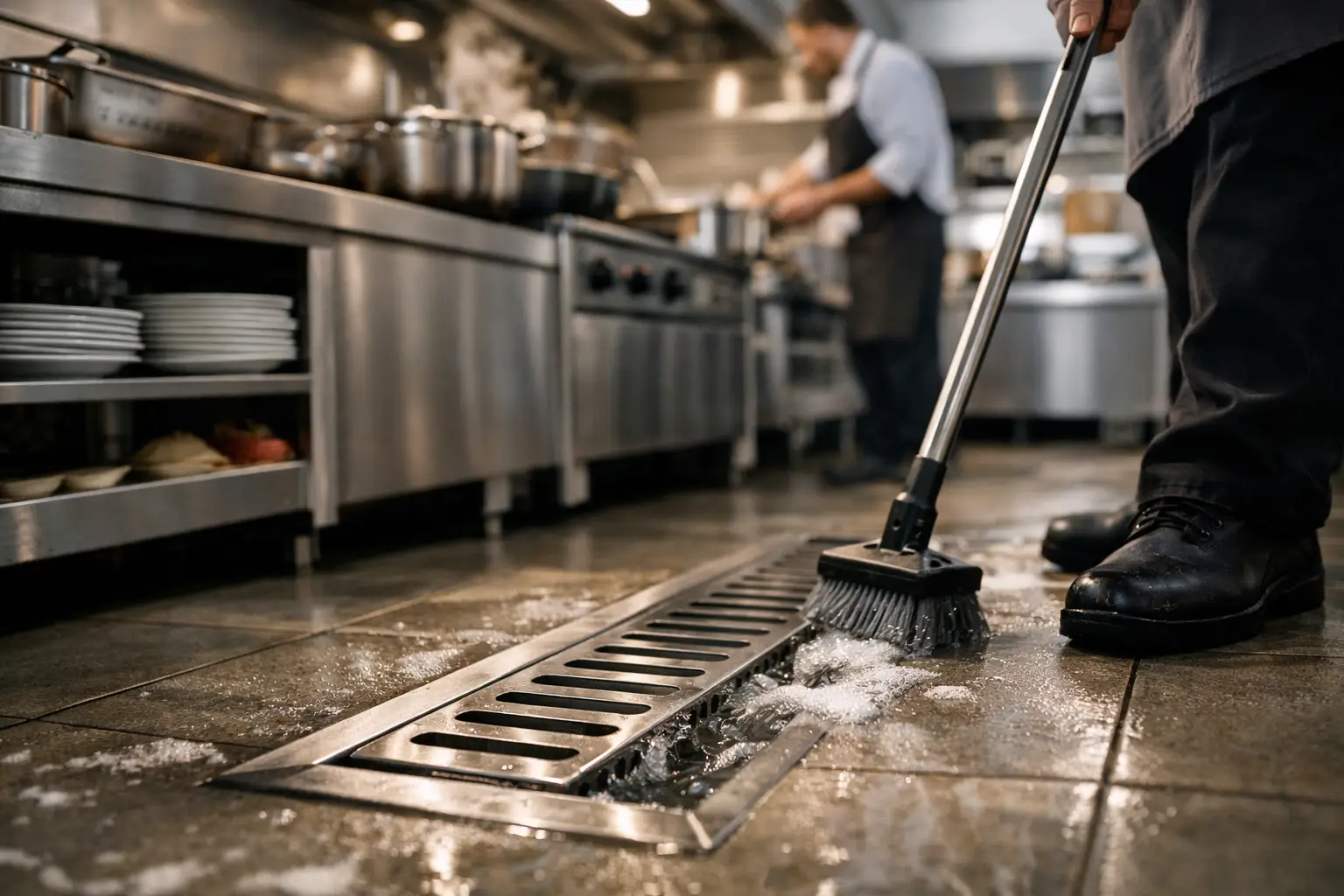
A restaurant drain usually does not fail all at once. It slows down first. The three-compartment sink lingers. The floor drain holds water a little longer than it should. The mop sink burps. Then a busy lunch rush hits, grease and food waste stack up, and the line finally gives out at the worst possible time.
That is usually the real answer behind how restaurant drains stay open – not luck, and not waiting until there is a full backup. Drains stay open when the buildup is removed completely, the source of the problem is identified, and the line is checked often enough to stop small issues from turning into shutdowns.
For restaurant owners and property managers, that matters because a slow drain is not just a plumbing problem. It affects cleanup, food prep, staff workflow, and health code risk. If the line serves a kitchen, even a partial blockage can create a mess fast.
How restaurant drains stay open in real kitchens
Commercial kitchen drains take a beating. Grease, fats, oils, food scraps, soap residue, and sediment all move through the same system. Even when staff are careful, some of that material sticks to the pipe walls. Over time it hardens, narrows the line, and catches more debris behind it.
A lot of people assume the fix is just opening the line enough for water to pass again. That may restore flow for the moment, but it does not always solve the real problem. If heavy grease is still coating the pipe, the drain is already on its way back to another clog.
Restaurant drains stay open longer when cleaning removes the full layer of buildup instead of punching a narrow hole through it. That is where proper equipment and inspection make a big difference. In many commercial lines, hydro jetting is what actually clears the pipe wall to wall. When scale, sludge, or grease is especially stubborn, a mechanical cleaning method may also be needed depending on the pipe material and condition.
The key point is simple. Good drain service is not about guessing. It is about clearing the restriction and verifying what is happening inside the line.
The biggest reason restaurant drains clog again
In most restaurant settings, grease is the repeat offender. It does not just sit in one spot like a solid object. It smears along the inside of the pipe, traps food particles, and slowly reduces flow. Hot water may move it for a while, but once it cools farther down the line, it sticks again.
That is why recurring kitchen drain issues often feel random to the owner. The sink may drain fine on Monday, slow down on Thursday, and back up completely the next week. What changed was not always usage. Often the buildup was already there, and one heavier shift pushed it over the edge.
There can be other causes too. Some restaurant lines develop scale inside older cast iron. Some have poor pitch, so waste does not move as cleanly as it should. Some exterior lines collect grease and sediment together, creating a heavier blockage farther downstream. In those cases, the right answer depends on what a camera inspection shows after cleaning.
That is an important trade-off to understand. Clearing the visible symptom is fast. Diagnosing why the same line keeps failing is what keeps operations moving over the long run.
Why routine cleaning works better than emergency calls
Emergency service matters when a drain is already backed up, but most restaurants benefit more from scheduled maintenance than repeated emergency visits. A planned cleaning gives the line attention before it reaches failure point. That means less downtime, less disruption to staff, and less chance of wastewater ending up where it should not.
The right schedule depends on the kitchen. A high-volume restaurant with heavy grease output may need service much more often than a smaller operation with lighter use. There is no honest one-size-fits-all answer. The cleaning frequency should match what the line is actually collecting, not what sounds convenient on paper.
That is why experienced drain specialists look at history, fixture use, and the condition of the pipe itself. If a line has already shown a pattern of grease accumulation every few months, the goal is to clean it before it reaches that threshold again. If the camera shows the line is staying relatively clean after a proper jetting, the schedule can be adjusted.
For busy operators in places like Bristow, Gainesville, and surrounding Northern Virginia communities, this kind of maintenance is often the difference between a manageable service visit and a kitchen disruption during peak hours.
What professional drain cleaning should actually accomplish
A real commercial drain cleaning should do more than make water disappear for the moment. It should restore strong flow, remove buildup as completely as the line safely allows, and give the customer a clear picture of what condition the pipe is in.
That last part matters. If a line is packed with grease, hydro jetting may be the right tool to scour it clean. If a pipe has scale or rough interior surfaces, descaling or mechanical cleaning may be needed. If roots, offsets, or damage are part of the issue, then cleaning alone may not be the full answer.
A camera inspection helps separate those situations. It shows whether the blockage is gone, whether residue is still hanging on the pipe walls, and whether there is a structural issue that will keep causing trouble. Without that verification, a restaurant owner is left hoping the problem is solved.
That is not how dependable service should work. If you are trusting a company to protect your operation, they should be able to show what they found and explain what comes next in plain language.
How restaurant drains stay open after the line is cleared
Once the line is properly cleaned, keeping it open comes down to consistency. Staff habits matter. Grease handling matters. Regular drain checks matter. But the biggest factor is whether the first cleaning was thorough enough to reset the line.
If the pipe is still coated after service, buildup returns quickly. If the pipe is cleaned thoroughly and monitored over time, maintenance becomes more predictable. That is a much better place to be for any restaurant trying to avoid interruption.
It also helps to think beyond the sink that is showing symptoms. In many restaurants, the visible problem is only the first fixture on the branch line. The real restriction may be farther down, where multiple fixtures tie together. A mop sink backing up may be connected to the same grease-loaded line affecting prep sinks or floor drains. Looking at the whole system, not just one opening, is what prevents partial fixes.
This is where specialized drain companies tend to bring more value than a basic quick-clear approach. When a technician has the right jetting equipment, flex-shaft tools when needed, and camera diagnostics, the work becomes much more targeted. Titan Jetters approaches commercial drain problems that way – clear the line, verify the result, and explain the next step without guessing.
Warning signs operators should not ignore
The earliest warning signs are usually subtle. Water draining slower than normal, recurring odors near a floor drain, gurgling sounds, or backups that seem to clear and return all point to buildup inside the line. None of those signs mean a full emergency yet, but they do mean the system is losing capacity.
The mistake many operators make is waiting until every sink is affected. By then, the line is usually far more loaded with grease, sludge, or debris than it was when the first symptoms appeared. The cleanup is bigger, the disruption is worse, and the pressure on staff is a lot higher.
Fast response matters, but early response is even better. A drain problem caught at the slow-stage is usually easier to manage than one caught during service with a kitchen full of dishes and nowhere for wastewater to go.
Restaurant drains do not stay open because they are used carefully once or cleaned only when they fail. They stay open when the line is treated like critical infrastructure – inspected, maintained, and cleaned thoroughly enough that flow is actually restored, not just temporarily patched. If your kitchen has started showing the early signs, that is the time to act, before a slow drain turns into lost time and a much bigger mess.
